
Decision-makers need tools that do more than justify costs. As transportation agencies face growing pressures such as the need for better access and reliability, improved infrastructure, and weather-related risk mitigation, they need tools that support smarter, more informed investments. Benefit-Cost Analyses (BCA) are evolving to meet this need. No longer just a grant requirement, modern BCAs are powerful instruments that can help agencies prioritize projects and demonstrate real-world economic value across a range of outcomes for a diverse group of stakeholders.
What Is Benefit-Cost Analysis?
.png)
BCA in transportation compares project costs to societal benefits which are derived from the project and which can be monetized. Source: Caltrans.
BCA is a systematic method for evaluating infrastructure investments by quantifying and comparing a project's expected benefits and costs over time. Benefits are typically measured in monetary terms and reflect the projected impacts of the project on both users and non-users, while costs include capital expenditures and ongoing maintenance requirements.
BCAs have long played a central role in supporting competitive transportation grant applications by quantifying the economic efficiency of proposed projects. Federal discretionary grant programs such as Better Utilizing Investments to Leverage Development (BUILD), Infrastructure for Rebuilding America (INFRA), National Infrastructure Project Assistance Program (Mega), Rural Surface Transportation Grant Program (Rural), and the Bridge Investment Program (BIP) require BCAs to compare quantified benefits such as travel time savings, reduced vehicle operating costs, and improved safety against capital costs to ensure that societal benefits outweigh the project investments. Programs such as Promoting Resilience Operations for Transformative, Efficient, and Cost-saving Transportation (PROTECT) use BCAs to compare alternatives and prioritize, while agencies apply BCA in planning and programming to evaluate the cost of delaying projects and to direct funding toward strategies that deliver the greatest long-term system value.
From Justifying Projects to Shaping Systems
Traditional BCAs focus largely on travel time savings, safety, and vehicle operating costs. These are important metrics but limited in scope. Today, transportation agencies are being asked to solve far more complex challenges:
How can interrelated projects be evaluated as a system, rather than as standalone assets?
How can benefit estimates be grounded in real-world operations and behavior (e.g., vessel routing, freight diversion, network effects), rather than generic assumptions?
How can broader community outcomes such access, safety, health, air quality, and land value be quantified in a defensible way?
What are the economic implications of inaction or delayed programmatic investment decisions?
Agencies need tools that reflect these broader mandates. BCAs can be rerouted from a compliance-based funding justification tool to a decision-making framework that informs coordinated planning, program design, and performance measurement.
Across jurisdictions, Cambridge Systematics (CS) has supported agencies in applying BCA to evaluate not only the discrete merits of individual projects but also to capture interdependencies, distributional impacts, and performance alignment.
Transforming Nine Bridges Into One Strategic Investment Story
.png)
This project represented a once-in-a-generation opportunity to bring critical stretches of I-95 and Rhode Island Route 10 (RI-10) up to a state of good repair. Source: RIDOT.
Agencies such as the Rhode Island Department of Transportation (RIDOT) have employed a systems-level BCA framework to assess interrelated projects submitted through federal discretionary programs such as BIP. Rather than evaluating each capital improvement independently, we helped RIDOT quantify the cumulative benefits of nine bridges serving vehicles along I-95. The bridges were combined into a “composite bridge” to represent the overall impacts of the bridges acting as a system. The approach captured shared dependencies among bridges located along the same roadway and integrated overlapping benefit streams, resulting in a defensible case for coordinated infrastructure investment and an award of $251.1 million.
A Smarter Model Supports a Stronger Port of Oakland
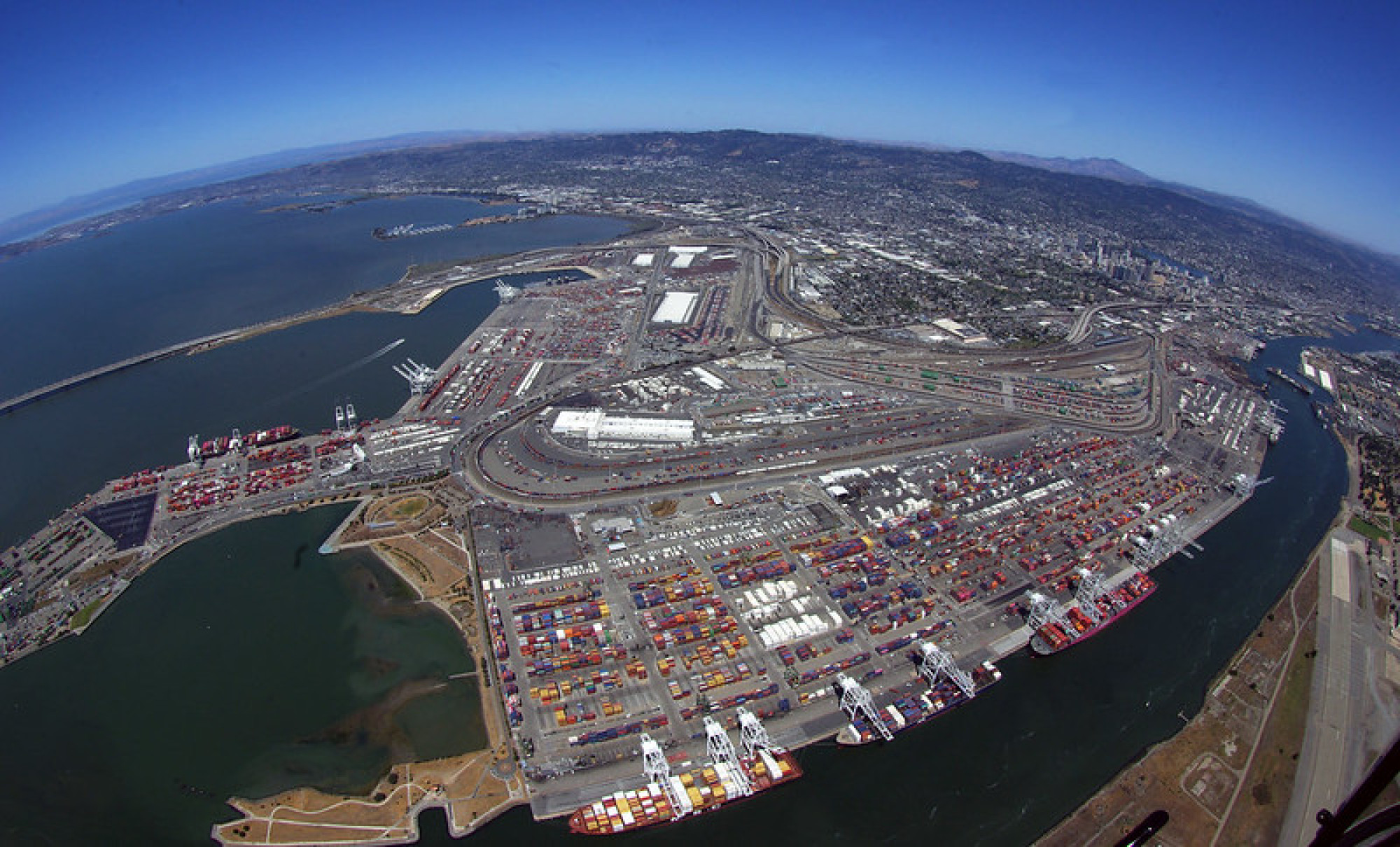
The Port of Oakland sought to update aging wharves which were not equipped to handle newer Ultra Large Container Vessels, ships that are more efficient, cost effective, and environmentally cleaner to operate. Source: Port of Oakland.
The Port of Oakland adopted a route‑specific, operations‑driven BCA framework to evaluate the benefits of the Berth 25/26 wharf modernization project. CS advanced the analysis beyond standard diversion factors by integrating carrier‑verified forecasts across four major shipping services to quantify how the loss of these routes would shift cargo to Los Angeles/Long Beach. This approach captured the full impact of diversion on truck travel, emissions, pavement wear, and safety by modeling 166 million avoided truck miles and 2.7 million containers that would not be diverted over the project life. By linking infrastructure improvements directly to vessel behavior, regional freight efficiency, and community impacts, the analysis delivered a defensible and market‑responsive case for investment grounded in real‑world operational dynamics, securing $49.5 million in Port Infrastructure Development Program (PIDP) funding for the Outer Harbor Terminal. This framework also supported the Port’s broader modernization strategy, which secured $36.6 million in PIDP funding for complementary improvements to the Outer Harbor Terminal.
Revealing the True Value of Mobility and Trail Connectivity
The LOOP is a 50-mile urban trail around the City of Dallas, connecting 39 miles of existing trail with 11 miles of newly built trail and increasing access to public transportation across the region by tying into two light rail stations. We helped the Texas Department of Transportation (TxDOT) secure funding for the final segment, the Trinity Forest Spine Trail, by evaluating benefits across several dimensions of safety, resiliency, mobility, economic competitiveness. The analysis rendered an impressive benefit-cost ratio of 2.4, securing a $12 million dollar award.
How BCA Guides Freight Planning and Prioritization
For TxDOT, BCA has also played a critical role in informing long-range freight planning and investment prioritization. As part of TxDOT’s Texas Freight Mobility Plan, BCAs were used to compare build and no-build scenarios across hundreds of high priority freight projects statewide. Rather than focusing on a single funded project, the analysis quantified the economic costs of not implementing proposed investments, including increased congestion, higher crash costs, and lost productivity for both freight and non-freight users. By translating these avoided costs into economic impacts such as jobs, income, and gross state product, TxDOT was able to use BCA as a strategic planning tool to prioritize freight investments and demonstrate the broader economic consequences of deferred action—well before entering a grant competition.
Practical Steps to Adapt BCA for Smarter Investments
BCAs are no longer just technical appendices for grant applications—they’re a strategic ally. BCAs are decision-support tools that can help agencies become more transparent, accountable, and intentional in how they allocate resources. By aligning BCA with strategic planning, agencies can ensure that every dollar spent supports not only economic efficiency but also a myriad of societal benefits, transportation access, and long-term resilience.
To unlock the full value of BCA, agencies should consider the following actions to broaden the scope, improve relevance, and strengthen decision support:
Expand Benefit Definitions: Broaden the scope of BCA beyond traditional benefits such as safety, travel time, and cost savings by incorporating metrics such as supply chain reliability, safety outcomes, emissions reductions, evacuation capacity, and access to essential services. Where feasible, apply monetization techniques to translate these factors into defensible benefit categories aligned with federal discretionary grant evaluation criteria.
Address Access Transparently: Quantify benefits for specific population groups (e.g., zero-car households, rural residents, older adults, financially distressed communities) to reflect spatial and demographic societal goals. Where appropriate, incorporate accessibility metrics like access to jobs, healthcare, and education.
Integrate BCA with Performance-Based Planning: Coordinate BCA with performance-based planning frameworks to ensure investment decisions are rooted in measurable outcomes. Use BCA results to inform corridor- and network-level prioritization tools, such as State Transportation Improvement Program (STIP) and Long-Range Transportation Plan (LRTP) development, and embed findings into scoring systems to promote consistent and transparent capital allocation.
Target Resilience and Continuity: For projects in areas vulnerable to extreme weather, assess impacts on network redundancy, freight diversion during extreme events, and long-term economic continuity. Demonstrating resilience benefits increases competitiveness in federal programs.
Bundle Projects with Shared Outcomes: Group interrelated investments (e.g., port, truck, and rail upgrades) into unified analyses to quantify cumulative and synergistic benefits. Consider infrastructure dependencies, such as vertical clearances or multimodal connections, to capture system-level performance improvements.
Connect With Us
CS has supported 86 successful grant applications, helping our clients secure more than $3.2 billion in funding. As the most experienced BCA experts in the industry, we help agencies apply BCA as a strategic tool for planning, prioritization, and performance based decision-making by building customized, goal-driven analysis frameworks that address today’s transportation challenges and support long-term investment decisions.
Our team combines leading-edge transportation economic analysis and BCA expertise with a proven track record across many major state and federal competitive programs. We also help agencies integrate BCA into planning and programming to support project prioritization, program screening, and alternatives evaluation. Let’s work together to turn your vision into the next success story.